

From market signals to financing strategies and upgrading decisions, explore curated learning to help you buy, sell, or invest with clarity and confidence.
From market signals to financing strategies and upgrading decisions, explore curated learning to help you buy, sell, or invest with clarity and confidence.
Recent Hot Topics Singaporeans Care About
How We Help You Learn
Our education ecosystem spans seminars, articles, market insights, tools, and data-driven frameworks to help every homeowner and investor make smarter decisions.
Start with our latest guides, insights, and explainers. Updated regularly to help you decode the Singapore property market.





Curated Content Just For You to Stay Ahead

Modern Homes, Familiar Neighbourhood: What's New in Bedok
From the local coffee shop and neighbourhood bakery to the convenience store around the corner, Bedok's established network of amenities reflects the familiarity and convenience that residents have come to value. A long-standing residential town, Bedok offers a well-established mix of community, amenities and connectivity. Now, a new housing project along New Upper Changi Road is set to introduce modern homes to the precinct, giving homebuyers fresh housing options. In a Government Land Sale (GLS) tender which closed on 1 September March 2026, the New Upper Changi Road plot garnered four bids, with the top bid tabled by a joint venture comprising UOL, Singland and CapitaLand at $1.425 billion (equivalent to a land rate of $1,537 psf per plot ratio). Notably, the top bid represents the highest land bid quantum for a pure residential GLS site since June 2022, when the Dunman Road site was awarded for $1.284 billion. The land rate also surpasses the previous record for an Outside Central Region (OCR) residential GLS site, set by the Bayshore Road site, which was awarded at $1,388 psf ppr in March 2025. Source: URA SPACE A New Chapter for BedokLocated at the intersection between New Upper Changi Road and Bedok South Road, the upcoming 3.1 hectares residential site can potentially yield more than 1,000 residential units, offering a substantial addition to the private housing stock in the East region. Given its scale, the future development could provide a range of unit types catering to different groups of homebuyers, from families looking to put down roots in an established neighbourhood to upgraders seeking a private condominium with access to familiar amenities.The wider East is also undergoing significant transformation, which could bring even more vibrancy and amenities to the area in the years ahead. The redevelopment of Paya Lebar Airbase from the 2030s is expected to introduce new homes, commercial spaces, community facilities and green spaces, creating a new mixed-use district in the future. Further south, the Long Island project is set to transform Singapore's eastern coastline, with plans for new waterfront homes, parks, recreational spaces and other amenities, alongside coastal protection measures. Together, these developments could further enhance the East region as a vibrant place to live, work and play.Source: UnsplashGateway to the East, and BeyondOne of the key advantages of the New Upper Changi Road site is its connectivity to the East region and other parts of Singapore. The site is served by Bedok MRT station on the East-West Line (EWL), providing commuters with direct access to major commercial hubs such as Paya Lebar, Bugis, Tanjong Pagar and the Central Business District. Meanwhile, the bus interchange at the integrated Bedok transport hub also provides convenient connections via the extensive bus network.For those who drive, the site's location along New Upper Changi Road provides access to major arterial roads connecting Bedok to other parts in the East and beyond. The nearby Pan Island Expressway (PIE) also offers motorists a direct route towards the city and other parts of Singapore.Connectivity in Eastern Singapore is set to improve further with the extension of the Thomson-East Coast Line (TEL) and other transport infrastructure. Together with the existing EWL network, these connections will enhance accessibility for residents travelling to their workplace, schools and lifestyle destinations across the island.Source: UnsplashEverything You Need, Close to HomeLiving in an established neighbourhood means residents will have no shortage of commercial offerings within the surrounding area. Bedok is home to major retail and heartland amenities, including the Bedok Market and Hawker Centre, Bedok Mall, and Bedok town centre where residents can find supermarkets, F&B options, essential services and a wide variety of shops. Beyond Bedok, there are also a diverse range of retail offerings in Tampines, Simei, Paya Lebar, Pasir Rise, and Jewel at Changi Airport. In particular, Tampines is home to major malls such as Tampines Mall, Century Square and Tampines 1, while Paya Lebar Quarter offers a mix of retail, dining and office spaces.There are also plenty of recreational options for residents. East Coast Park is a short drive away, providing opportunities for cycling, jogging and seaside strolls. Meanwhile, Bedok Reservoir is also minutes away, offering a tranquil setting for leisurely walks, runs and water sports. With its wide range of lifestyle and recreational amenities, Bedok continues to appeal to buyers who value convenience and lifestyle options close to home.Source: UnsplashA Neighbourhood for Growing FamiliesFamilies may be drawn to the upcoming project in view of the number of primary schools in the vicinity, including Opera Estate Primary School, Bedok Green Primary School, Red Swastika School, Yu Neng Primary School, Fengshan Primary School, Damai Primary School, and Telok Kurau Primary SchoolBesides primary schools, there are also secondary and pre-university educational institutions in the area - such as Victoria School, CHIJ Katong Convent, St Patrick's School, Bedok View Secondary School, Anglican High School, Victoria Junior College, and Temasek Junior College which are located within the broader Bedok and Marine Parade planning areas. Rounding off the wide spectrum of educational options, Temasek Polytechnic and ITE College East are also not too far from the site.Source: UnsplashDeveloperUOL Group is a leading developer and public-listed firm with a proven track record of more than 60 years. It boasts a a diversified portfolio of development and investment properties, hotels and serviced suites in Asia, Oceania, Europe, and North America. Some of its notable residential projects include Skye at Holland, Upperhouse at Orchard Boulevard, Parktown Residence, and Meyer Blue. CapitaLand is one of Singapore's leading public-listed property developers, with a portfolio focused on real estate investment management and real estate development. CapitaLand Development (CLD) is the development arm of CapitaLand Group, focusing on its core markets of Singapore, China and Vietnam across various asset classes, including integrated developments, retail, office, residential, business parks, industrial, logistics and data centers. Some notable residential projects include Skye at Holland, Parktown Residence, LyndenWoods, J'den, and CanningHill Piers. Singapore Land Group, formerly United Industrial Corporation Limited, is a partly-owned subsidiary of the UOL Group. Singapore Land too, has a diversified portfolio comprising commercial investment properties, residential developments, hotels and IT services. Its residential development properties include Clavon, Avenue South Residence, The Tre Ver, V on Shenton, and Pinetree Hill.
Read More
That Free Share Of Your Parents' Property May Follow You Into ABSD
TL;DR That "free" share of your parents' property could affect how much you pay for your next home. Even if you inherit or receive a property share as a gift, it can still count towards your property count for ABSD purposes. Why it matters: Inherited or gifted residential property is generally included in your property count if you still own the interest when buying another Singapore residential property. A small share still counts: Owning just 10% or one-third of a property can still count as owning a property for ABSD purposes. The size of your share does not reduce the count. The potential cost: A Singapore Citizen who inherits a share of a property could face 20% ABSD on their next home instead of 0% if that purchase is treated as their second residential property. Family plans matter: Adding a child to a property title or leaving them a share in a will may seem fair today, but it could affect their ability to buy their own matrimonial home later. Plan before transferring: Families should consider whether cash, other assets, or a different ownership structure could achieve the same succession goals without limiting a child's future housing options. Bottom line: Inheritance may come without ABSD at the point of transfer, but the property can still follow you into your next home purchase. Before adding a name to the title or finalising a will, consider how the arrangement could affect each beneficiary's future property plans and get legal and tax advice. If your parents add your name to the family property, or leave you a share of it in a will, would you treat that as a gift or as your first property purchase?Most adult children would say it's a gift. Fair enough. Nobody thinks of it as house-hunting when the property decision is driven by a parent wanting a clear succession plan, or by siblings inheriting equal shares after a death.But as far as IRAS is concerned, a property is still a property. To them, it doesn't matter if the property is acquired through inheritance, gift, release, settlement, declaration of trust, letter of authority or exchange. As long as you still own that interest when you acquire another Singapore residential property, it will generally be included in your property count for Additional Buyer's Stamp Duty (ABSD) purposes.That's the part many families overlook. In this article, we will explore: No duty on the inheritance, but a future property count Good intentions, unintended consequences Every family is different Remissions are not automatic What Should Families Do? Final thoughts No duty on the inheritance, but a future property countSingapore abolished estate duty for deaths on or after 15 February 2008. That much is true, and it explains why many families now think of inherited property as relatively clean from a tax point of view.There is also no Buyer's Stamp Duty or ABSD payable on the inheritance itself when property passes under a will, the Intestate Succession Act, or Muslim law. So if a parent leaves a property share to an adult child, the transfer is pretty straightforward.But as mentioned earlier, the issue is that the inherited property is still included in the recipient's property count when ABSD is assessed for future purchases. The size of the share does not change the count. Even a 10 per cent or one-third interest in a property is treated as ownership of that property for ABSD purposes.Many buyers already know that ABSD rises by property count. For Singapore Citizens, the current ABSD rate is 0 per cent for their first residential property, 20 per cent for their second, and 30 per cent for their third or subsequent property.That means someone who would otherwise pay no ABSD on their first home could instead end up paying 20% ABSD on the full purchase price or market value because the inherited property is treated as their first property.Here's an example. An adult child inherits a one-third share of a parent's private property, while still planning to buy a matrimonial home later. Then, the child buys a $1.3 million home. Before considering any applicable remission, the purchase would be treated as their second residential property. At the current 20 per cent ABSD rate, that works out to $260,000, calculated on the higher of the purchase price or market value.A seemingly harmless share can become a six-figure problem. Enjoying our insights so far? Stay updated with the latest property trends, expert analysis, and market perspectives from PropNex. Join our mailing list Good intentions, unintended consequencesNobody sets out to create an ABSD problem. Most families are simply trying to do what seems fair or practical at the time.A parent might add one child's name to the property because that child has been the main caregiver. A will might leave the family home equally to all the children because equal feels like the right thing to do. Or an old co-ownership arrangement is never revisited because there never seemed to be a reason to.Years later, that same child starts looking for a home of their own. It is often only when they apply for financing or speak to a conveyancing lawyer that the inherited share suddenly becomes an ABSD issue.But by then, they've probably already set a budget, shortlisted a few units, and mentally treated the inheritance share as something separate from their own homebuying plans. It is awkward to tell a sibling, spouse or parent that a family arrangement now affects the purchase of a completely different home.Every family is differentWhen it's an only child receiving the inheritance, it's more straightforward. But if the inheritance is spread across siblings, things can get more complicated.For example, one sibling might want to keep the family home, while the others would rather receive their share in cash. Of course, the one sibling can buy out the others' shares, but that transaction may have its own stamp duty implications.There can also be disagreements over timing. One sibling may want to sell the property immediately, while another hopes to hold onto it because they believe prices will rise. In the meantime, each sibling's own housing plans continue.Remissions are not automaticCertain buyers may qualify for targeted stamp-duty remissions, but these should not be treated as a general solution.For example, an eligible married couple purchasing a replacement residential property jointly may qualify for an ABSD remission if the required conditions are met, including selling the first property within the prescribed period.Separately, some transfers of HDB flats within a family may qualify for Buyer's Stamp Duty (BSD) and Seller's Stamp Duty (SSD) remission. This is not the same as a general ABSD waiver.Eligibility depends on the ownership structure, the buyers' profiles, the type of property and the timing of each transaction. Families should therefore confirm the applicable requirements before transferring or acquiring any property interest.What Should Families Do?Of course, the solution isn't to avoid inheritance altogether, but to make sure it fits the family's long-term housing plans. So before you decide how you want to distribute your property asset, here are some thing you might want to consider:Who is likely to buy a home next?If one child is planning to purchase a matrimonial home within the next few years, perhaps helping your child purchase a home now might be more helpful than leaving a property share later.Does everyone actually need a share of the property?Equal isn't always the same as fair. Children who already own a home may benefit more from receiving cash or other assets of equivalent value instead of a property interest.Can the ownership structure be planned differently?Depending on the family's circumstances, there may be alternative ways to achieve the same succession goals while avoiding unnecessary stamp duty implications. It's best to obtain legal and tax advice before executing the transfer or finalising the will. Once ownership has changed, unwinding the arrangement may itself create further stamp-duty consequences.Final thoughtsEstate duty may be gone, but that doesn't mean succession planning is separate from homebuying. In Singapore, where homeownership is the norm, the two often go hand in hand.A share that looks modest on paper can still count as an entire property for ABSD purposes. At the same time, an arrangement that appears equal among siblings may not give each child the same degree of housing flexibility.It's no longer just about who should receive the property. You need to also think about how asset inheritance can affect each beneficiary's next home, finances, and long-term plans.Good succession planning should preserve options rather than create an ownership structure that the family later struggles to undo. So make sure to have these conversations before the will is finalised or any name is added to the title, and obtain legal and tax advice based on the family's actual circumstances.Plan ahead so that your children won't have to deal with unexpected tax consequences years later when they're ready to buy their own homes. Views expressed in this article belong to the writer(s) and do not reflect PropNex's position. No part of this content may be reproduced, distributed, transmitted, displayed, published, or broadcast in any form or by any means without the prior written consent of PropNex. For permission to use, reproduce, or distribute any content, please contact the Corporate Communications department. PropNex reserves the right to modify or update this disclaimer at any time without prior notice.
Read More
Planning A Family? Why Your Next Home Matters More Now
TL;DR Singapore's latest family measures may give parents more time, support and flexibility, but they do not automatically mean families need a bigger home. The more useful question is whether the property you choose today can continue to support the family life you are planning for tomorrow. The home that works for two may not work for four: Children can change how bedrooms, workspaces, storage and common areas are used, making future household needs worth considering before buying. Space is only one part of the equation: Proximity to grandparents, childcare, schools, workplaces and transport may be more valuable to a growing family than simply having a larger home. Timing matters too: Buying additional space too early can mean carrying higher costs before they are necessary, while moving too late could mean managing a sale, purchase and renovation during an already demanding stage of family life. Bigger does not automatically mean better: Children bring additional household expenses, so stretching the property budget for more space can reduce the financial flexibility a growing family may need elsewhere. Family planning and property planning should happen together: Think beyond what suits your household today and consider how changes in family size, careers, caregiving needs and support networks could affect the home you need later. Bottom line: The right family home is not necessarily the largest or most expensive one. It is the home that gives your household enough space to grow, enough financial room to breathe and enough flexibility for life to change. Suppose you are planning your first child within the next two years.Do you stretch for the extra bedroom now, or keep the mortgage smaller and move later?It is the kind of housing decision many couples eventually face. And after Singapore's National Day Rally on 23 August 2026, parts of that calculation are changing.Prime Minister Lawrence Wong announced a broader package of support for families, including more childcare leave, sustained financial support as children grow, lower preschool fees over time and housing measures aimed at improving access to different housing options.These measures could give parents more time, lower some caregiving costs and create greater flexibility.What they do not do is make a larger home automatically more affordable.That distinction matters.More family support can widen the options available to a household. It should not be mistaken for more property-purchasing power.And that makes the more useful housing question not simply whether you can afford something bigger, but whether the home you choose still leaves enough room for family life to change. Content Table: More Leave, More Life, But What Actually Changes? The Home That Works For Two May Not Work For Four Planning A Family? Timing Your Home Purchase Matters Too Considering A Bigger Flat? Not So Fast. Housing Support Is Changing Alongside Family Support Four Questions To Ask Before Your Family Grows More Support Does Not Mean More Houses Your Family Plan And Property Plan Should Talk To Each Other More Leave, More Life, But What Actually Changes? Under the new childcare leave framework announced at NDR 2026, each eligible working parent will receive eight days of childcare leave a year with one Singapore Citizen child aged 12 and below, 10 days with two, and 12 days with three or more.The Government will also reimburse employers for the full duration of statutory child-related leave schemes, up to the applicable reimbursement limits. The start date for the new childcare leave scheme, however, has not yet been announced.Financial support will also extend much further through a child's growing years.Together with existing benefits, every eligible Singapore Citizen child will receive around S$70,000 in direct financial support from birth to age 17. Government-supported full-day childcare and infant care fees are also targeted to fall to S$150 and S$300 a month respectively, with reductions beginning progressively from 2028 and target levels expected by 2030.New childcare leave implementation date to be announced. Preschool fee reductions will be rolled out progressively from 2028, with target levels by 2030.These are meaningful changes.But consider what happens if a household simply adds the savings or support to the amount it thinks it can spend on housing.Lower preschool costs do not necessarily justify a larger mortgage. Additional financial support is intended to help meet the cost of raising children, not to become another housing budget. More childcare leave creates time, but it does not change loan limits or remove the risks of stretching household finances.The bigger change may therefore be flexibility.A household with more breathing room may have more choices over when to move, whether one parent changes working arrangements, how much cash flow to preserve, or whether a housing upgrade is necessary at all.That is a very different proposition from simply buying more.The Home That Works For Two May Not Work For Four A couple buying a home before having children is making a decision with incomplete information.The spare bedroom may feel unnecessary today. A location further from family may be perfectly manageable. A longer commute may not matter much when there are only two schedules to coordinate.Then the household changes.Suddenly, the same property is being asked to accommodate children, working arrangements, caregiving and a very different daily routine.That is why the more useful question is not:"How much space do we need now?"It is:"How much flexibility will this home give us later?"Space is only one part of the answer.A family's housing needs can be influenced just as much by location and support networks as by square footage.For one household, a 4-room HDB flat close to grandparents may make daily childcare considerably easier than a larger home much further away.For another, an additional bedroom may genuinely matter because both parents work from home.The point is not to predict the perfect family home years in advance.It is to recognise which features may be less straightforward to change later, and which could be adjusted if your needs evolve.Planning A Family? Timing Your Home Purchase Matters Too Consider the two choices facing a couple planning to have a child.They could buy ahead of their needs today, perhaps paying more for the additional room they expect to use later.Or they could keep their current housing commitment smaller and move only when the need becomes clearer.Neither option is automatically better.Buying ahead may reduce the disruption of moving with a young child later. But it also means carrying the cost of extra space before the household actually needs it.Waiting preserves financial flexibility. But wait too long, and a couple could find themselves trying to sell, buy, renovate and move at precisely the point when family life becomes more demanding.There is also a third approach that some financially stronger, ambitious, childless couples may consider: using their lower current financial burden to build a property position before having children.For example, a couple may buy one condominium to live in and another new-launch property that is still under construction, or BUC. During the building period, mortgage repayments on the BUC property tend to be lower because the loan is typically disbursed progressively as construction advances. If the couple carefully plans how to finance the property upon TOP, including the eventual increase in repayments, this can be a prudent and very achievable strategy. Many people are unaware of this opportunity and may miss out on what could be a golden window to secure a future family home before they need it. The intention may be to hold both through the development period, then sell them and consolidate into one larger family home when they are ready to have children.On paper, this can appear to offer a way to use the years before parenthood strategically. The couple may have two incomes, fewer recurring family expenses and more flexibility to tolerate construction timelines, interest-rate changes and market fluctuations.Holding two properties also gives the couple the option of collecting rental income. Once the second property has obtained TOP, they may choose to rent it out, generating passive income that can help offset the mortgage and other holding costs.If the couple later starts planning for a family and decides that a larger home is more suitable, they could also choose to sell both properties and use the combined proceeds towards a home that better fits their needs.The strategy therefore depends on more than having enough income today. It requires a clear exit plan, sufficient liquidity and a realistic assessment of what the household can still carry if the market or family timeline changes.This is where timing becomes part of affordability.The question is whether the decision still works alongside the household's likely expenses, income changes and major family milestones over the next several years. Most people also do not have a clear way to determine how much of their financial capacity should be allocated to a property purchase or investment.This means looking beyond the maximum loan amount. The aim is to structure the household's finances and use its available purchasing power prudently, without leaving the family overextended. A property purchase should therefore not be viewed as a single transaction.It sits inside a much longer household timeline.Sometimes, when a family moves can matter just as much as where it moves.Considering A Bigger Flat? Not So Fast. For growing families, the most obvious response is often to look for more space.Sometimes that is exactly what is needed.But "bigger" should not become shorthand for "better".An extra bedroom comes with a price. So does a larger floor area or a more expensive location.Moving between public and private housing can also introduce different eligibility, timing and transaction-cost considerations.At the same time, children bring recurring expenses that extend far beyond preschool.Food. Healthcare. Transport. Insurance. Education. Activities. Daily necessities.Some of these costs are predictable. Others are not.This means there is value in retaining financial margin.A family that can technically service a larger mortgage may still decide that keeping monthly housing costs lower gives it more freedom if one parent's income changes, childcare arrangements fall through or another child comes along.There are also less obvious ways to "upgrade" family life. More square footage is one option.But a better location, a more functional layout, shorter journeys or a more manageable mortgage may improve family life just as much. Enjoying our insights so far? Stay updated with the latest property trends, expert analysis, and market perspectives from PropNex. Join our mailing list Housing Support Is Changing Alongside Family Support NDR 2026 also introduced housing changes that could affect some couples' options.The monthly household income ceiling for eligible families purchasing new subsidised HDB flats will increase from S$14,000 to S$16,000.The monthly household income ceiling for new Executive Condominium units will rise from S$16,000 to S$18,000.But the two measures should not be interpreted too broadly.The revised HDB income ceilings apply to eligible households applying for an HDB Flat Eligibility letter from 24 August 2026.For ECs, the S$18,000 ceiling applies only to new units on sites where the land-sale tender closes on or after 24 August 2026. It does not automatically extend to balance units in existing EC projects or sites tendered earlier.There is also additional support specifically for first-timer families with children.From the February 2027 sales exercise, eligible first-timer families will receive one additional ballot chance for every Singapore Citizen child aged 18 and below, including a child they are expecting, when applying for BTO and Sale of Balance Flats.Source: MND/HDB, NDR 2026. Revised HDB income ceilings apply to HFE applications from 24 Aug 2026. The revised EC ceiling applies to new units on sites with land-sale tenders closing on or after 24 Aug 2026. Additional ballot chances apply from the February 2027 sales exercise.The purposes of these changes are slightly different.The extra ballot chances have an explicit aim: helping first-timer families with children secure a flat sooner.The higher income ceilings address another issue, keeping subsidised public housing and new ECs accessible to a wider share of Singaporean households as incomes rise.Taken together, the changes give some families more housing options.But once again, having more options is not the same as needing to spend more.Four Questions To Ask Before Your Family Grows Instead of starting with:"Should we buy a bigger home?"Start with four questions. Where these trade-offs point in different directions, a more structured review can help.PropNex's Property Wealth System (PWS) 1-Day Property Decision-Making Workshop uses the PWS Pressure-Test(TM) to help consumers compare affordability, their current property position and how different choices could affect what remains possible afterwards. The emphasis is not on finding a generic "best" property, but on testing whether a particular decision fits the household making it.More Support Does Not Mean More Houses There is a simple trap in looking at the latest family measures.More support arrives, so perhaps the household can afford to take on more.But affordability is not merely about whether a bank will lend the money or whether today's monthly instalment fits.It is also about the margin left after the property is paid for.A couple planning one child may find its current home works perfectly well for years.Another household may decide that moving nearer to its parents matters more than increasing floor area.A third may qualify for a more expensive housing option but deliberately choose not to use the full extent of that purchasing power.A fourth may consider buying two properties before having children, but decide that the risks and commitments are too high relative to the flexibility it wants to preserve.All four could be rational decisions.The objective is not to maximise the amount of property a family can buy or hold.It is to choose a housing strategy that remains workable when the rest of life refuses to follow the plan.Your Family Plan And Property Plan Should Talk To Each Other For couples planning children, the better test is not simply:"Can we afford this property today?"It is:"Will this home or housing strategy still work if one income dips, childcare arrangements change, the BUC is delayed or our parents need more help?"If the entire plan depends on both careers progressing exactly as expected, every caregiving arrangement remaining available, property values moving favourably and every future expense staying within budget, there may be too little margin for error. As with all investments, property decisions carry certain risks, and those who are unsure should seek professional advice before proceeding.That is the distinction worth taking away from NDR 2026.Singapore is giving families more support as they raise their children.That support may create more time, more financial breathing room and, for some households, more housing options.Your property decision should not take all of that flexibility away again. Views expressed in this article belong to the writer(s) and do not reflect PropNex's position. No part of this content may be reproduced, distributed, transmitted, displayed, published, or broadcast in any form or by any means without the prior written consent of PropNex. For permission to use, reproduce, or distribute any content, please contact the Corporate Communications department. PropNex reserves the right to modify or update this disclaimer at any time without prior notice.
Read More
Record 201 million-dollar-flats resold in August; non-mature towns set a second straight monthly record of such sales
A string of records fell in August, including a new monthly high of million-dollar resale flats sold - crossing the 200-unit mark for the first time. The number of such units sold was also at a monthly high in both mature, and non-mature estates. In particular, non-mature HDB towns posted the second straight month of record million-dollar resale flat transactions in August. According to HDB sales data, 24 flats were sold for at least $1 million in the month, surpassing the previous monthly high of 21 units set in July. Hougang led with 14 such deals - double the seven done in the previous month - followed by Woodlands with five. The remaining five were in Bukit Batok, Bukit Panjang, Jurong East and Sengkang. In the first eight months of 2026, 134 million-dollar flats were resold in non-mature towns. That is already close to the 139 units resold in the whole of 2025, with four months of the year still to run. Overall, 201 resale flats were transacted for at least $1 million in August, up by 7.5% from 187 units in July. It breached the previous record of 188 units resold in June (see Chart 1). Year-to-date, 1,290 million-dollar flats have changed hands - the record 1,593 such units sold in the whole of 2025 should be comfortably exceeded this year at this rate. Chart 1: Number of HDB flats resold for at least $1 million by monthSource: PropNex Research, data.gov.sg (retrieved on 1 September 2026) By flat type, the million-dollar flats resold in August comprised 82 units of 4-room flats, 65 units of 5-room flats, 53 executive flats, and a 3-room terrace flat in Queenstown. Of note, executive flats featured more prominently than in July, when 35 such units were sold for at least $1 million. There were 177 units of million-dollar resale flats sold in mature estates in August - a new monthly high. Toa Payoh led with 32 such deals, ahead of Queenstown with 26 and Bukit Merah with 21 such transactions. Toa Payoh's showing is mainly due to newer flats resold in Bidadari Park Drive and Alkaff Crescent, which accounted for 24 out of the 32 million-dollar-resale flat deals in Toa Payoh. The priciest resale flat in August was a five-room unit in Boon Tiong Road, Bukit Merah, which fetched $1,688,888 (see Table 1). The 112-sqm flat at Tiong Bahru View sits on a high floor between the 28th and 30th levels, and has a lease balance of around 88 years. Table 1: Top 10 HDB resale flats sold in August 2026 by Transacted PriceTownTypeStreetStorey rangeFloor area(SQ M)Lease start dateResale pricePSF ($)BUKIT MERAH5 ROOMBOON TIONG RD28 TO 301122016$1,688,888$1,401BISHANEXECUTIVEBISHAN ST 1322 TO 241621987$1,650,000$946BISHAN5 ROOMBISHAN ST 2431 TO 331202011$1,620,000$1,254CLEMENTI5 ROOMCLEMENTI AVE 322 TO 241132021$1,580,000$1,299BISHANEXECUTIVESIN MING AVE19 TO 211601990$1,550,000$900QUEENSTOWN5 ROOMDAWSON RD40 TO 42992016$1,510,000$1,417QUEENSTOWN5 ROOMGHIM MOH LINK34 TO 361132013$1,500,000$1,233TOA PAYOH5 ROOMLOR 1A TOA PAYOH22 TO 241142012$1,490,000$1,214CENTRAL AREA4 ROOMCANTONMENT RD40 TO 42932011$1,475,000$1,473BUKIT MERAH4 ROOMBOON TIONG RD37 TO 39932016$1,468,000$1,466Source: PropNex Research, data.gov.sg (retrieved on 1 September 2026) Two towns set new price records in August. In Bishan, an executive maisonette in Bishan Street 13 was resold for $1.65 million, above the town's previous high of $1.632 million. It is also the highest price paid for an executive flat on record. The 162-sqm unit is located between the 22nd and 24th floor, and has about 60 years of lease remaining - suggesting that spacious unit size and a location near the town centre, an MRT station, and schools can still command a strong premium in the older flat stock. Meanwhile, in Bedok, a five-room flat in Bedok South Road (Bedok South Horizon) was resold for $1.45 million, topping the town's previous high of $1.4 million, also at Bedok South Horizon. Chart 2: HDB resale volume and average resale price Source: PropNex Research, data.gov.sg (retrieved on 1 September 2026) Resale volume eased from July's two-year highResale volume came off slightly in August, with 2,521 flats sold (see Chart 2) - down by 4.9% month-on-month (MOM) from the 2,651 units transacted in July, which was the highest monthly sales tally in two years. The towns that led resale transactions in August were Tampines, Punggol and Woodlands. The average resale price rose by 1.0% MOM to around $667,000 in August, from about $660,700 in July, reversing the previous month's marginal dip from June. The price growth can be partly attributed to the higher number of million-dollar flats resold in the month. Based on the sales data, the proportion of flats resold below $500,000 was 20.9% in August, down from 21.7% in July. About 42.0% of flats resold fetched between $500,000 and under $700,000, on par with 41.9% in the previous month. The share of deals done at $700,000 to just under $1 million was largely unchanged at 29.1%, from 29.3% in July. Meanwhile, the proportion of resale flats transacted for at least $1 million rose to 8.0%, from 7.1% in July (see Chart 3). Chart 3: HDB resale flat transactions by price rangeSource: PropNex Research, data.gov.sg (retrieved on 1 September 2026) By flat type and town classification, average resale prices in mature estates rose across the board in August, while prices in non-mature towns were broadly flat (see Table 2). Executive flats in mature estates recorded the largest increase, with the average price rising 7.5% MOM to about $1.06 million. This was partly driven by a heavier concentration of higher-priced deals within a relatively small pool of 65 executive flat transactions during the month. Three-room flats in mature estates saw the next-largest gain at 3.4% MOM to about $493,800, partly reflecting resale deals done at projects that have recently exited their 5-year minimum occupation period (MOP), such as in Clementi Avenue 1, Tampines Street 61, Margaret Drive, Alkaff Crescent and Dawson Road. Looking ahead, the withdrawal of the 15-month wait-out period measure could likely bring more buyers to the market, as private home owners who wish to right-size to a non-subsidised HDB resale flat (without taking HDB loan or grants) can do so without any delay. Table 2: Average HDB resale flat prices by flat type, by town classificationFlat TypeMature townsNon-mature townsJul-26Aug-26% change MOMJul-26Aug-26% change MOM3 ROOM$477,654$493,7933.4%$448,898$448,423-0.1%4 ROOM$780,495$789,3301.1%$598,715$599,5410.1%5 ROOM$913,532$926,5681.4%$711,246$713,0250.3%EXECUTIVE$989,972$1,064,1217.5%$871,317$873,9840.3%Source: PropNex Research, data.gov.sg (retrieved on 1 September 2026) Contact a PropNex salesperson to find out more about resale HDB market trends.
Read More
Should You Sell Before The Condo Completion Wave Lands?
TL;DR A wave of new condo completions is coming, which could mean tougher competition for existing owners. Around 27,300 private homes (including ECs) are expected to be completed by end-2028, compared with just 7,996 in 2025. More supply: New homes could put pressure on resale demand and rents, although the impact will vary by location and property. Check your SSD: For properties bought from 4 July 2025, SSD applies for four years, starting at 16% in the first year. On a $2 million property, that's up to $320,000. Look beyond the sale price: Factor in your loan, CPF refund, SSD and the cost of your next home before deciding whether selling actually puts you in a better position. Bottom line: Don't panic-sell just because more supply is coming. But don't hold by default either. Review your property's competitiveness, rental prospects, SSD exposure and what your sale proceeds can do for your next move. If your condo has been renting well and the valuation still looks healthy, you wouldn't even think about selling. Why would you even do that?Well, there will be a wave of new completions in the coming years. And many owners do not consider this, or at least they don't do it early enough. In this article, we will explore: The market you bought into may not be the one you sell into. How it might affect rental market Don't forget about SSD Selling only works if the next move makes sense Don't panic, here's what you can do The market you bought into may not be the one you sell into. From 2020 to 2023, holding a condo felt like the obvious decision. Rents rose, vacancies tightened, and resale demand was supported by buyers who were priced out of new launches. But the market has shifted since.Recently, URA announced in its June 2026 Government Land Sales (GLS) announcement that around 4,000 private homes (including ECs) will be added to the pipeline. That brings the total number of private homes expected to enter the market from around 57,000 units to roughly 61,000 units.On its own, that number doesn't mean much. But take a look at when these homes are expected to be completed.According to URA's Q1 2026 real estate statistics, around 27,300 units (including ECs) are expected to be completed by the end of 2028, with another 28,500 units coming from 2029 onwards. To put that into perspective, only 7,996 units were completed in the whole of 2025.In other words, the number of homes due for completion between now and the end of 2028 is about 3.5 times the total completed in 2025.So why should current owners care about this?Essentially, if you're planning to sell or rent out your home in the next few years, you may not be competing with just the projects around you today. You'll also be competing with thousands of brand-new homes entering the market at around the same time. More choices for buyers and tenants usually mean tougher competition for existing owners.Of course, this does not mean every owner should rush to sell. Some should hold. Some cannot sell yet without taking a painful SSD hit. But if your plans rely on today's rental income and resale demand holding up through 2027 and 2028, you might need to rethink some things.How it might affect rental marketFor now, it seems that rents have recovered since the 2024 losses, with rental index going up 0.3 per cent from 160.9 in Q4 2025 to 161.4 in Q1 2026. But, given that most of the new supply has yet to arrive, how long can that recovery hold?Of course, no one can predict how the market will react for sure. We can only assume that there's a big possibility rents will moderate again once the new supply comes in. So this is another thing owners need to consider.Vacancy rates also tell a mixed story. At the end of Q1 2026, the vacancy rate for completed private homes, excluding ECs, stood at 6.2 per cent. That was slightly higher than the 6.0 per cent recorded in the previous quarter, although still below the 6.9 per cent seen in Q3 2025.Vacancy also varies by region. It was highest in the CCR at 8.2 per cent, followed by the RCR at 6.3 per cent and the OCR at 5.2 per cent. So an OCR owner should not look at the overall market and assume the same risks as a landlord in the CCR. The impact of new supply will depend heavily on where the property is located. Regardless, more completed homes usually mean more choice for tenants and less room for landlords to push rents. This may not immediately appear as a sharp fall in the rental index. It could first show up as longer marketing periods, more bargaining, or tenants asking for a discount because a newer unit is available nearby. Enjoying our insights so far? Stay updated with the latest property trends, expert analysis, and market perspectives from PropNex. Join our mailing list Don't forget about SSDEven if selling before the completion wave makes sense, SSD could make an early exit too costly.For properties bought on or after 4 July 2025, SSD applies for four years, starting at 16 per cent in the first year and falling 4% each year after that. On a $2 million property, that could mean as much as $320,000 in SSD.So if your property is still within the SSD timeline, you need to calculate whether selling earlier still leaves you better off. On the other hand, owners who are already SSD-free have more flexibility to decide based on the outlook for their unit, rather than the tax cost of exiting. Selling only works if the next move makes senseSelling before the completion wave may sound like a smart exit, but you still need somewhere to go next.You could sell at a good price, only to find that your next home requires a bigger loan, comes with less space, or is in a less desirable location. That is why the gain on your current property means little until you compare it with the cost of your next move.For some owners, selling and renting temporarily may make sense. Others may choose to right-size, while landlords with a healthy rental yield may still be better off holding.Don't panic, here's what you can doWhen you hear "supply wave", you might think "price crash". But don't be so quick to jump to such conclusions.All in all, private home prices still rose 0.9 per cent in Q1 2026, with the CCR, RCR and OCR all recording gains. Buyers have not disappeared. It's just that sellers may face more competition as new homes are completed.Whether you should hold or sell depends on the unit you own and your next move. So before the 2027 and 2028 completions arrive, ask yourself these questions:Is your property still within the SSD period?Selling early may trigger an SSD which will eat into your gains. Check exactly when your SSD period ends before making a move.How will your unit compare with the new competition?Think about your unit's age, layout, location, MRT and school access, tenure, and scarcity. Then look at how many newer projects are completing nearby.How much rent could your unit realistically achieve in a more competitive market?More choices for tenants could mean longer marketing periods and more bargaining. Be realistic about the rent your unit can achieve, rather than assuming current rates will continue.How much would you walk away with if you sold now and what can your proceeds do for you next?Gross profit is always flattering, but you need to account for CPF refunds, outstanding loan, SSD (if applicable), and the cost of your next home. That final figure will tell you whether selling now genuinely puts you in a better position.At the end of the day, your decision should be deliberate. Do not sell simply because more supply is coming, but do not hold by default either. You may also like: Before You Buy, Ask This: Are You Able To Sell It Later? Views expressed in this article belong to the writer(s) and do not reflect PropNex's position. No part of this content may be reproduced, distributed, transmitted, displayed, published, or broadcast in any form or by any means without the prior written consent of PropNex. For permission to use, reproduce, or distribute any content, please contact the Corporate Communications department. PropNex reserves the right to modify or update this disclaimer at any time without prior notice.
Read More
Should You Sell Your Condo And Move Back To An HDB Flat?
TL;DR The 15-month wait is gone for eligible private homeowners, but that does not automatically make moving from a condo to an HDB a good financial decision. The real question is how much wealth the move actually releases after your mortgage, CPF movements, replacement-home costs and transaction sequence are accounted for. Your condo's selling price is not your spendable money: An outstanding mortgage, CPF housing refund and the cost of your replacement HDB can substantially reduce the cash ultimately unlocked from the move. Crossing age 55 can change the CPF equation: Housing refunds may flow differently once you reach 55, so selling the same property at 52 and 58 could leave you with a different amount immediately available for your next home. Buying first and selling first create very different cash-flow demands: Buying the HDB before disposing of your condo may make the physical move easier, but your CPF and sale proceeds could still be tied up in the condo, increasing the upfront funding required. Watch the price gap, not just property prices: You are simultaneously selling a condo and buying an HDB. What matters is how the value of the home you own moves relative to the HDB you actually intend to buy. Waiting has an opportunity cost: Your mortgage may shrink and your condo may appreciate, but CPF accrued interest continues building, your target HDB may become more expensive and crossing 55 may alter how your CPF refund is treated. Bottom line: The policy change tells you that you may no longer need to wait 15 months. Your numbers should tell you whether moving from a condo to an HDB actually leaves you better positioned for retirement. For some private homeowners, the removal of the 15-month wait-out period has reopened a property option that may previously have been too troublesome to seriously consider.Since late July 2026, eligible private residential property owners and former owners buying a non-subsidised HDB resale flat without an HDB housing loan no longer need to observe the 15-month wait. An existing private homeowner may also proceed with the HDB purchase first, provided the private residential property is subsequently disposed of within six months of completing the flat purchase.For someone sitting on a condo that has appreciated substantially over the years, the possibilities are obvious. Sell the private property, move into an HDB flat that still meets the household's needs, and potentially free up a sizeable amount of housing equity for retirement.But the removal of the wait changes when you can make the move. It does not tell you whether the move actually leaves you financially better off.A $1.8 million condo and an $850,000 resale flat may appear to create a $950,000 opportunity at first glance. Once the outstanding mortgage, CPF housing refund, purchase funding, stamp duties and transaction sequence are considered, however, the amount you truly unlock can look quite different.So if you are seriously considering moving from a condo back to an HDB flat, these are the numbers that matter. What we'll cover in this article: First, has the rule change actually opened a new door for you? Your $1.8 million condo is not $1.8 million of spendable money Selling at 52 and selling at 58 can produce a different CPF outcome Buy the HDB first or sell the condo first? What about ABSD if you buy before you sell? Don't just ask whether HDB prices will rise The number that may matter more is the gap What if you wait another two or three years? Four numbers to know before you decide When the question is bigger than "sell or hold" The wait is gone. The trade-off is not. First, Has The Rule Change Actually Opened A New Door For You? There is one important detail that can easily be missed in the headlines.Before the 15-month wait-out period was removed, Singapore Citizens aged 55 and above and their spouses were already exempt from the restriction if they were moving from private residential property into a 4-room or smaller non-subsidised resale flat without taking an HDB housing loan.That means a 60-year-old condo owner who had always intended to buy a 3-room or 4-room resale flat did not suddenly gain this option in July 2026.The latest change is more consequential for private homeowners below 55 who may already be considering their next phase of housing, as well as older homeowners whose preferred replacement home falls outside the previous exemption.There are still boundaries. The 30-month wait-out requirement continues to apply in situations such as buying a flat directly from HDB, purchasing certain subsidised resale flats, taking an HDB housing loan or buying a new Executive Condominium.So before evaluating whether condo-to-HDB right-sizing makes financial sense, establish that the particular HDB route you are considering actually falls within the new rules.Once it does, the next question is where the maths becomes much more interesting.Your $1.8 Million Condo Is Not $1.8 Million Of Spendable Money Suppose David and Elaine are both 52. Their children are becoming increasingly independent and they own a condominium currently worth around $1.8 million.They are considering an $850,000 resale HDB flat.At first glance:$1.8 million condo - $850,000 HDB = $950,000It is tempting to view that $950,000 as the amount available for retirement.But suppose the condo still carries a $250,000 mortgage and David and Elaine have used $400,000 in CPF savings, including accrued interest that would need to be refunded upon sale.Their starting calculation would look more like this: Illustrative calculation Amount Condo selling price $1,800,000 Less outstanding housing loan ($250,000) Less CPF housing refund ($400,000) Approximate cash sale proceeds before other selling costs $1,150,000 When a property is sold, the sale proceeds are first used to repay the outstanding housing loan and make the required CPF housing refund. In general, the CPF amount to be refunded comprises the principal withdrawn for the property and the accrued interest; additional refund requirements may apply to certain members aged 55 and above who have pledged their property towards their retirement sum.The $400,000 going back to CPF has not disappeared. For David and Elaine, who are below 55 in this example, the housing refund would generally return to their Ordinary Accounts and could potentially be used towards another property, subject to the prevailing CPF housing rules and limits.If they subsequently use that $400,000 of CPF towards the $850,000 HDB purchase, alongside $450,000 in cash, the broad picture becomes:$1.15 million cash proceeds - $450,000 cash used for the HDB = $700,000That $700,000 is still before costs such as legal fees, applicable stamp duties, agent fees, renovation, moving expenses and other transaction costs.The example is simplified, but it illustrates an important distinction. The $950,000 difference between property prices and the cash that ultimately becomes available after the entire move are not necessarily the same number.Before deciding whether selling the condo will meaningfully improve your retirement position, calculate the latter.Selling At 52 And Selling At 58 Can Produce A Different CPF Outcome The CPF calculation becomes even more important when the homeowner is approaching 55.For members below 55, CPF housing refunds are generally credited back into the Ordinary Account. Once a member is aged 55 and above, housing refunds are first used to top up the Retirement Account towards the Full Retirement Sum (FRS), with the remaining refund staying in the Ordinary Account.Consider the same $400,000 CPF housing refund in David and Elaine's example.At 52, that refund would generally return to their OAs, where it could potentially be redeployed towards the next property subject to CPF housing rules.If they make the move after 55 and their Retirement Accounts have not yet met the applicable Full Retirement Sum (FRS), part of the housing refund may instead be channelled there first. Their condo may sell for exactly the same price, but the amount immediately available in their OAs for the replacement home could be different.This does not mean that the money has been lost. It means more of it has been set aside to support retirement.There are also specific provisions for eligible homeowners aged 55 and above buying a 3-room or smaller HDB flat. CPF allows Retirement Account refunds above the Basic Retirement Sum (BRS) to be used towards such a property purchase if the relevant conditions are met: the replacement flat must be bought within three years of selling the previous property, it must cost less than the previous property's selling price, and the member must not yet have been issued a CPF LIFE plan.The broader lesson is that "Should I sell at 52 or 58?" is not purely a property-market question.Crossing 55 can change how CPF savings flow through the transaction. Someone considering a move within the next few years should therefore understand their CPF position alongside their property's estimated sale proceeds rather than treating the two as separate decisions.Buy The HDB First Or Sell The Condo First? This is another area where the removal of the 15-month wait makes the move easier, but does not eliminate the need for planning.Under the current rules for the eligible non-subsidised resale route, an existing private homeowner may purchase the HDB flat first and dispose of the private residential property within six months of the HDB resale completion.For some homeowners, buying first is appealing. They can secure the HDB flat they want, renovate it and perhaps move directly from one home to the next without needing temporary accommodation.But there is a financing question hiding inside that convenience.If much of your available CPF remains tied to your condo and most of your cash is expected to come from its eventual sale, how will you fund the HDB purchase before those proceeds are released?Return to David and Elaine.If they sell the condo first, the mortgage can be discharged, the CPF refund can be processed and the net cash proceeds become clearer before they commit to the next property.If they buy the $850,000 HDB first, however, the $400,000 of CPF in our example has not yet been refunded because the condo has not been sold. The expected $1.15 million of cash sale proceeds has not arrived either.They may therefore need considerably more existing cash or other financing to complete the HDB purchase first. There is also a bank-loan consequence to retaining the condo mortgage. For an individual with one outstanding housing loan, current bank loan-to-value limits are generally 45%, falling to 25% where the lower-LTV conditions apply; the minimum cash downpayment is 25%. By comparison, the normal maximum LTV is 75% where there is no outstanding housing loan. On an $850,000 HDB purchase, that can mean a much larger upfront funding requirement than a buyer may expect if the condo loan is still outstanding.This is why the disappearance of the 15-month wait should not be confused with the disappearance of the funding gap between two transactions.For some households, selling first produces greater financial certainty. For others, buying first may be worth the temporary liquidity requirement because the right replacement flat is difficult to find.The better sequence depends not merely on which market you think will move first, but on whether your finances can comfortably support the overlap.What About ABSD If You Buy Before You Sell? The stamp-duty position can also sound more alarming than it necessarily is.HDB purchases are subject to specific ABSD remission rules because HDB regulations already require buyers to dispose of other residential property within the stipulated period. Where the applicable conditions are met, the remission can reduce or remove the additional stamp-duty burden that might otherwise arise from owning another residential property at the point of purchase.This does not mean stamp duties can be ignored altogether. Buyer's Stamp Duty still forms part of the acquisition cost, and the precise treatment can depend on the buyers' citizenship and ownership circumstances.But for many right-sizers, the more immediate transaction constraint is likely to be cash flow and CPF availability, rather than simply assuming that buying the HDB before selling the condo automatically creates an enormous ABSD bill.That distinction matters when planning the order of the two transactions.Don't Just Ask Whether HDB Prices Will Rise One concern surrounding the removal of the 15-month wait has been whether former private-property owners will rush into the HDB resale market and reignite price growth.The timing of the policy change provides some context. HDB resale prices declined by 0.1% in Q1 2026, followed by another 0.3% decline in Q2, after several consecutive quarters of moderating price growth.The newly eligible demand pool is also narrower than it first appears. Older owners moving into 4-room or smaller flats already had an exemption, while households seeking subsidised housing or an HDB housing loan remain subject to other eligibility conditions.None of this guarantees that the particular HDB flat you want will become cheaper. A newer 5-room flat near an MRT station can behave very differently from an older flat elsewhere, just as one condo project can perform very differently from another.That is why a homeowner moving between the two markets should arguably focus on something more useful than either headline index alone. Enjoying our insights so far? Stay updated with the latest property trends, expert analysis, and market perspectives from PropNex. Join our mailing list The Number That May Matter More Is The Gap Suppose your condo is worth $1.8 million today and the type of HDB flat you intend to buy typically costs around $850,000.The gross price gap is:$950,000Now imagine both markets move over the next two years.If comparable condos rise to $1.9 million while your target HDB segment rises to $900,000, the gap becomes $1 million. Waiting may have worked in your favour, even though the HDB flat itself became more expensive.But if your condo remains at $1.8 million while suitable HDB flats rise to $900,000, the gap falls to $900,000.The HDB buyer sees a $50,000 increase. The right-sizer should see something else: $50,000 less gross housing equity available to be released through the move.These are deliberately simplified examples, but they show why asking only whether "condo prices will rise" or "HDB prices will fall" misses the interaction between the two transactions.A right-sizer is simultaneously a seller in one market and a buyer in another.Private residential performance is itself far from uniform. In Q2 2026, overall private residential prices rose by 0.5%, but non-landed prices slipped by 0.1%. Within the non-landed segment, prices rose by 1.8% in the Core Central Region, declined by 1.2% in the Rest of Central Region and eased by 0.1% in the Outside Central Region.So the relevant comparison is not simply "private versus HDB".It is the condo you actually own versus the HDB flat you would realistically buy.Source: PropNex Investment Suite, URA.gov.sgWhat If You Wait Another Two Or Three Years? Waiting can sound attractive if you expect your condo to appreciate further. But delaying the decision changes more than one variable.Your outstanding mortgage may fall, which could improve your eventual net sale proceeds. Your condo may appreciate, but the HDB segment you are targeting could appreciate too. Your CPF accrued interest continues to build while CPF remains deployed for housing, affecting the eventual refund amount. If you cross age 55 during that period, the treatment of those housing refunds may also change.There is therefore no single market forecast that can answer whether waiting is better.Imagine two homeowners with identical $1.8 million condos.The first still owes a substantial mortgage, has significant CPF tied up in the property and intends to retire within a few years. The second owns the condo outright, has ample retirement assets outside property and has no immediate need for liquidity.Even if they have identical expectations for condo prices, the financial value of selling today can be completely different.That is why the decision should be judged against the household's own balance sheet rather than on whether the private market is expected to gain another few percentage points.The question is not simply:"Can my condo still go up?"It is:"What do I gain by keeping this amount of wealth in the condo for another two or three years, and what do I give up by not releasing it today?"That is an opportunity-cost calculation, not merely a property forecast.Four Numbers To Know Before You Decide Before deciding whether a condo-to-HDB move makes financial sense, work through these four numbers first. Taken together, these four numbers give you a more realistic picture of what moving from a condo to an HDB flat could actually change financially. The key is not simply the difference between the two property prices, but what remains after your mortgage, CPF movements, purchase costs and other expenses have been accounted for.Only then can you assess whether the move meaningfully strengthens your retirement position.When The Question Is Bigger Than "Sell Or Hold" Those four numbers provide a useful baseline. But property decisions rarely come down to one calculation.A homeowner considering a condo-to-HDB move may simultaneously be asking whether to sell now or wait, whether the replacement home is affordable without overstretching, how CPF should be deployed, what market movements mean for the price gap, and what the decision leaves open for the next five, 10 or 20 years.For homeowners who want to examine those trade-offs in greater depth, PropNex's Property Wealth System (PWS) offers a structured way to assess their options through a PWS Pressure-Test. This framework helps homeowners evaluate their current property position, test different property strategies against their financial goals and consider how each decision may affect their future property wealth. EXPLORE THE 1-DAY PWS WORKSHOP > The Wait Is Gone. The Trade-Off Is Not. The 15-month wait-out period once forced many private homeowners to think carefully about whether moving back into the HDB resale market was practical at all.For eligible buyers, that particular obstacle has now been removed.What remains is arguably the more important question.Does selling the condo improve the way your wealth is positioned for the next stage of your life?The answer will not come from the condo's selling price alone. It depends on the mortgage still attached to it, how much CPF has been used, your age when you sell, the HDB you genuinely want, how the two market segments are moving relative to one another and what you intend to do with the capital that is ultimately released.If you are still deciding whether a smaller home fits your retirement lifestyle in the first place, that is a broader right-sizing conversation. But once you have reached the point where condo to HDB is a serious option, the next step is to put the transaction itself under the microscope.The policy change tells you that you may no longer have to wait 15 months.Your numbers should tell you whether the move is worth making. Views expressed in this article belong to the writer(s) and do not reflect PropNex's position. No part of this content may be reproduced, distributed, transmitted, displayed, published, or broadcast in any form or by any means without the prior written consent of PropNex. For permission to use, reproduce, or distribute any content, please contact the Corporate Communications department. PropNex reserves the right to modify or update this disclaimer at any time without prior notice.
Read More
Resale Landed Market Watch In July 2026
Resilient Resale Landed market activity in JulyIn July, sales momentum in the landed home resale market picked up after a brief pause during the June school holiday. Based on URA Realis caveat data, about 195 landed homes were transacted on the resale market in July 2026; with a combined transaction value came up to $1.15 billion - slightly lower compared to June (202 deals valued at nearly $1.3 million). Upon an analysis of each transaction and their respective gains, most landed deals were profitable. There was a smaller proportion of higher priced landed homes being sold compared with the previous month that came despite a pick-up in sales activity. Based on URA Realis caveat data, about 48.2% of resale landed homes sold in July were priced at $5 million and above, compared with about 52.0% in June. Meanwhile, 51.8% of the resale landed transactions were priced at below $5 million in July - rising from the 48.0% proportion in the previous month. Chart 1: Price range of private resale landed transactions in June 2026 vs July 2026Source: PropNex Research, URA Realis Overall landed home resale prices in July 2026 improved from the previous month, amid the improvement in sales volumes. The overall landed homes resale prices grew by 5.3% month-on-month (MOM) to $2,070 psf; while prices were up by 15.1% compared to a year before. By property type, detached, semi-detached, terrace homes grew 5.7%, 15.3% and 1.5% MOM, respectively. By region, homes in the Core Central Region (CCR) and Rest of Central Region (RCR) expanded by 3% and 23.4%, respectively. Meanwhile homes in the Outside Central Region (OCR) bucked the upward trend, declining 2.2% (see table 1 below). Table 1: Average Unit Prices ($PSF) of Resale Landed Homes by monthSource: PropNex Research, URA Realis Resale landed homes performance by property type in July 2026 Table 2: Top 3 resale landed transactions by landed property type, in terms of estimated gains*Source: PropNex Research, URA Realis*Gains are derived from the resale transaction for each unit against the unit's last caveated transaction. The gains reflected is gross - it has not accounted for the applicable seller's stamp duties, interest payable, taxes and other relevant divestment costs. **Annualised gain is the compounded annual rate of return which shows the rate of return over the time period between the point of resale and the property's last caveated transaction, expressed in annual percentage terms. The formula for determining this is simply: [(current resale price) / (purchase price)] time period in years-1 Top landed transaction with highest gains (Detached) The top performing detached home transaction and overall landed transaction for the month was for a Good-class bungalow along Swettenham Road in District 10 (Tanglin) that was sold for $31.8 million, up by $25.1 million from the last caveat lodged in September 2006 - this reflects an annualised profit of 8.2% after a holding period of nearly 20 years. The corner GCB plot is situated within the Ridout Park Good-class Bungalow (GCB) estate. Top landed transaction with highest gains (Semi-Detached) The best-performing semi-detached transaction was for the sale of a semi-detached property in Watten Park in Bukit Timah (District 11). It was sold for $11.1 million in July, with its last caveat being lodged in June 1998. The sale price is up by $9.1 million from the previous caveated price, representing an annualised gain of 6.4% per year for a holding period of nearly 30 years. The semi-detached house property is situated within walking distance to Tan Kah Kee MRT station. Top landed transaction with highest gains (Terrace House)The best-performing terrace home transaction was for a terrace house along Westerhout Road in the Geylang planning area (District 14). The freehold property is situated a short distance away from Upper Mountbatton MRT station, and was sold for $7.5 million, reflecting an estimated gain of $4.7 million, representing an annualised gain of 6.7% per year from its last caveat lodged in April 2011, with a holding period of about 15 yearsIf you are looking for high-end homes or good class bungalows in Singapore, contact PropNex's GCB and Prestige Landed department for buying and insights on the landed residential property market.For more property research insights, join PropNex Friends today.
Read More
A Home Where Someone Died?!
TL;DR A death in a home can affect buyer demand, but it does not automatically make a property unsellable or significantly cheaper. How much it matters often depends on the circumstances, the buyer, and how attractive the property is otherwise. The circumstances matter: Buyers may react differently to a peaceful death compared to a suicide, homicide or widely reported incident. Stigma can affect price: There is no fixed discount in Singapore, but if fewer buyers are willing to consider the home, sellers may need to adjust their asking price. Buyers should ask clearly: Sellers may not have to volunteer every detail, but they should not give false or misleading answers when directly asked. The fundamentals still matter: Location, layout, condition and price can still outweigh a property's history for the right buyer. Bottom line: Whether a death in a home matters is personal, but buyers and sellers should consider one important question: will the next buyer care? It's that time of the year again. The Hungry Ghost Festival has begun. Offerings and joss paper are everywhere, and ghost stories suddenly become everyone's favourite conversation topic. So here's one more to add to the list.Would you buy a home where someone died? Or, what if you're the one selling that home?Does a death actually affect a property's value? Are you required to tell buyers? And can a home with such a history ever be just another home again? In this article, we will explore: Why does one death feel more personal than thousands of old graves? Does the manner of death matter? Can death affect the value of a home? Buyer beware, but that does not permit a misleading answer One last goodbye Why does one death feel more personal than thousands of old graves? Singapore is a small island with limited land, which means land gets repurposed all the time. As our city developed, many former cemeteries have been exhumed and redeveloped into housing estates, parks, schools, expressways and other public infrastructure.Some well-known examples include Bidadari, which was once one of Singapore's largest cemeteries before it was transformed into a new housing estate. Another one is Bishan, where the former Peck San Theng cemetery eventually gave way to today's town. Even the grounds beneath several roads, MRT lines and public facilities have undergone similar transitions over the decades.So most of us have probably walked, worked or even lived on land where people were once buried, yet the thought rarely crosses our minds.But if you're looking at resale properties and your agent tells you the previous owner passed away in one of the bedrooms, you'll probably think twice before making an offer, even if the unit is perfect in any other way.So why do we react so differently?Maybe it's because a former cemetery feels like history, while a home feels more personal. It's much easier to imagine the person who lived there. You picture them cooking in the kitchen, watching TV in the living room or sleeping in the bedroom. Some people just find the thought uncomfortable. Others may worry about whether the home is haunted.That being said, not every death carries the same weight in buyers' minds.Does the manner of death matter?Some people actually might not mind if the previous owner had passed away peacefully after living in the home for decades, especially if there's a discount.However, a suicide, homicide or unattended death can leave a much stronger impression, particularly if the incident was widely reported. Even if you're not superstitious, you might reconsider purchasing such a home because it might be hard to sell later on, which brings us to our next point:Can death affect the value of a home?Well, it depends on how many buyers are still willing to consider it.Unlike valuation methods or stamp duties, there isn't an official formula that says a property where someone died must be worth a certain percentage less. In the end, it all comes down to demand.While we don't have studies on how much death in the home affects property values in Singapore, a 2018 study in Hong Kong found that homes where an unnatural death had occurred sold for about 25% less on average than comparable properties.More importantly, the effect was not limited to the unit itself. Homes on the same floor also saw price declines, albeit smaller. Researchers also found that the impact varied depending on whether the death was a suicide, murder or accident. The spillover effect on nearby homes began to reverse after around four to five years, but the discount on the affected unit itself was more persistent.But that doesn't mean every home in Singapore will see a similar discount. A rare unit in a sought-after location may still attract plenty of interest, while another property could take longer to sell simply because buyers have more alternatives. Ultimately, the property's history can affect its price and value, but it's not automatic.The spillover effect on nearby homes began to reverse after around four to five years. However, the study found that the discount on the affected unit itself was more persistent. Enjoying our insights so far? Stay updated with the latest property trends, expert analysis, and market perspectives from PropNex. Join our mailing list Buyer beware, but that does not permit a misleading answerThis is probably the question most homeowners really want answered.In a resale-property transaction, the general starting point is caveat emptor, or "buyer beware". Buyers are expected to make their own enquiries before deciding whether a home is acceptable to them. There does not appear to be a general legal requirement for every seller to volunteer that someone previously died in the property.But caveat emptor is not permission to mislead. If a buyer directly asks whether a death occurred in the home, the seller or salesperson should not give a false answer, conceal the truth through a misleading half-statement or present an assumption as fact.So the practical distinction is between not volunteering information that was never requested and misrepresenting the property's history after a specific question has been asked. A buyer who considers this important should ask clearly and record the answer before committing to the purchase.One last goodbyeIn a city where land is limited, neighbourhoods evolve and generations come and go, it's only natural that some properties will have witnessed both life's happiest moments and its final ones.For buyers, whether that's something you can live with is a deeply personal decision. Some may not care at all, while others may feel uncomfortable regardless of the circumstances. Practical considerations, such as future resale potential, may also come into play.For sellers, a death in the home doesn't automatically make a property unsellable. While certain circumstances may narrow the pool of interested buyers, location, layout, condition and asking price will still influence whether the remaining buyers see sufficient value.The useful question is not whether you personally believe a home can carry a stigma. It is whether the next buyer might. A buyer who accepts such a property should therefore expect compensation through price, while a seller should recognise that silence does not remove the concern; it may merely postpone it until the buyer or salesperson raises the question. In property, beliefs do not have to be rational to affect demand. Views expressed in this article belong to the writer(s) and do not reflect PropNex's position. No part of this content may be reproduced, distributed, transmitted, displayed, published, or broadcast in any form or by any means without the prior written consent of PropNex. For permission to use, reproduce, or distribute any content, please contact the Corporate Communications department. PropNex reserves the right to modify or update this disclaimer at any time without prior notice.
Read More
Singapore Needs More Homes. But Where Do We Build Them Next?
TL;DR Singapore is not running out of housing plans. The harder question is where those homes should go. The debate over Maju Forest and Gillman Barracks shows how future housing decisions will increasingly involve balancing supply, greenery, heritage and liveability on the same limited land. The housing pipeline remains substantial: Singapore has tens of thousands of public and private homes planned, but every new home still needs land that is available at the right time and in the right location. The real constraint is increasingly timing: Brownfield sites such as former golf courses, industrial areas and eventually port and airbase land can provide future housing, but many cannot be redeveloped immediately. Existing land will have to work harder: Higher density, mixed-use integration and redevelopment can accommodate more people without requiring proportionally more land, provided infrastructure grows alongside housing. Greenery is part of liveability, not simply unused housing land: As neighbourhoods become denser, parks, ecological corridors and open spaces become increasingly important to making higher-density living sustainable. Homebuyers should pay attention to what surrounds their property: Master plans and future land-use changes can reshape an entire neighbourhood, making the question of what an area is becoming just as important as what exists there today. Bottom line: Maju Forest and Gillman Barracks are not simply a choice between homes and greenery. They reveal a bigger challenge Singapore will face more often: How to keep building enough homes while preserving the qualities that make increasingly dense neighbourhoods worth living in. For weeks, the debate around Maju Forest and Gillman Barracks appeared to centre on a familiar tension in land-scarce Singapore: build more homes, or preserve more greenery?On 4 August 2026, Minister of State for National Development Alvin Tan told Parliament that the current conceptual plans for both sites had already been adjusted to retain important green and heritage areas, and that conserving more would necessarily mean building fewer homes. He also emphasised that the plans for Gillman Barracks and the Sunset Way (Maju Forest) area were not final, and would continue to be refined based on public feedback. The public consultation period closed on 6 August.That framing matters. It means the discussion is not about a fixed decision, but an evolving set of trade-offs still being worked through.Singapore still needs new homes. If fewer can be accommodated on one site, that demand does not simply disappear.So where do we build them instead?And as Singapore becomes increasingly developed, could decisions such as Maju Forest and Gillman Barracks offer an early glimpse of how much harder that question will become? What we'll touch on in this article: Two Sites, One Difficult Trade-Off Singapore Isn't Running Out Of Housing Plans Why Do We Still Need More Homes? The Land Decisions Are Getting Harder Existing Land Has To Work Harder Greenery Is Not Simply "Lost Housing Land Gilman Barracks And The Southern Transformation Maju Forest: Designing With Nature As A Starting Point Where Does The Housing Go If Not Here? What This Means For Homeowners Singapore Needs Both Homes And A liveable City Two Sites, One Difficult Trade-Off Under the initial proposal for Maju Forest along Sunset Way, about two-thirds of the roughly 23-hectare forest was proposed for public housing, while the remaining areas would be retained as wildlife refuges and ecological corridors.At Gillman Barracks, the former military site and surrounding forest have been identified for a roughly 40-hectare mixed-use residential neighbourhood comprising both public and private housing, with portions of greenery retained within the broader development.Neither plan is final.During the consultation and stakeholder engagements, nature groups proposed wider green corridors at both locations. At Gillman Barracks, this could improve ecological connections towards Telok Blangah Hill Park, Labrador Nature Reserve and HortPark. At Maju Forest, a more continuous corridor could strengthen habitat connectivity for wildlife. The authorities have said these suggestions will be considered as plans are refined.It is easy to frame the situation as development on one side and conservation on the other. In reality, the planning challenge is more layered.The Government has maintained that both sites are part of Singapore's medium-term housing pipeline. At the same time, it has noted that alternative sites raised by the public are often already earmarked for other uses, required for national needs, or not yet ready for redevelopment.That is what makes the issue particularly interesting from a property perspective.The question is not simply whether Singapore should build homes at Maju Forest and Gillman Barracks.It is how many homes can reasonably be accommodated there, what should be preserved, and how the remaining housing demand is absorbed elsewhere in the system.Singapore Isn't Running Out Of Housing Plans One thing is clear from the numbers: Singapore continues to plan for a substantial housing pipeline. For private homes, the Confirmed List under the Government Land Sales Programme is expected to supply 9,320 units in 2026, more than 50% higher than the annual average over the previous decade.Following the second-half 2026 land supply announcement, the overall pipeline of private residential units, including Executive Condominiums, stood at about 61,000 units, with a significant share already unsold and potentially released over the next few years.Looking further ahead, about 60,600 private residential units including ECs are expected to be completed in the coming years, with roughly 25,900 by 2028 and another 34,700 from 2029 onwards.The public housing pipeline is similarly substantial.HDB plans to launch about 19,600 BTO flats in 2026 across three sales exercises, with more than 4,000 offering waiting times of under three years.HDB is also prepared to offer more than 55,000 flats from 2025 to 2027 if necessary, depending on demand and market conditions, with 127 projects already under construction at the start of 2026.Put together, these figures reveal an important distinction.Singapore is not facing a shortage of housing plans.It is facing the harder question of where a large and continuous pipeline of housing should physically go.Why Do We Still Need More Homes? Singapore's housing requirement is not determined by population growth alone.Even if the population remains stable, the number of homes required can still rise as household sizes shrink. More singles are forming independent households, young couples are setting up their own homes, and an ageing population means more seniors may live alone.The arithmetic is simple. If 10,000 people live in households averaging four people, they require about 2,500 homes. If the same population shifts to households averaging two people, the requirement doubles to 5,000 homes.The population has not changed. The number of households has.This is why housing demand cannot be understood purely through population figures. Household formation, ageing, and lifestyle changes all matter.There is also a spatial dimension.Singaporeans tend to value proximity to transport, jobs, schools, family and amenities. This means housing supply is not just about total units, but about where those units are located.Recent BTO projects in established estates illustrate this demand. During the parliamentary discussion, Mr Tan pointed to strong application rates for projects such as Clementi Emerald and Berlayar Rise.The pressure is therefore not only to produce more housing.It is to produce housing in well-connected, established locations where land is increasingly scarce.The Land Decisions Are Getting Harder For a small city-state, land has always been scarce. What is changing is the nature of the trade-offs.Many future residential sites already contain existing value: forests, golf courses, industrial estates, heritage precincts, institutions, or transport infrastructure.Singapore's planning response has increasingly focused on brownfield redevelopment: reusing already-developed land for new purposes.The former Keppel Golf Course is a clear example. It is expected to accommodate about 10,000 public and private homes, including the Berlayar estate, where HDB flats are already entering the pipeline.The former Old Police Academy is being transformed into the Mount Pleasant estate, which is expected to provide around 5,000 homes.Other sites will emerge as existing uses are relocated, consolidated, or reach the end of their leases.This approach reduces pressure on undeveloped land.But it introduces a timing constraint.Brownfield land does not become available on demand. Some transformations take decades. The Greater Southern Waterfront depends on port relocation to Tuas. Paya Lebar Air Base can only be redeveloped after aviation operations move in the 2030s.This creates a structural mismatch between:where land will eventually become available, andwhere housing is needed in the near termThat is the underlying tension Maju Forest and Gillman Barracks sit within.They are not just individual sites. They are part of a system where timing, not just availability, is the constraint. Enjoying our insights so far? Stay updated with the latest property trends, expert analysis, and market perspectives from PropNex. Join our mailing list Existing Land Has To Work Harder Because of this timing gap, Singapore has increasingly had to make each parcel of land do more.One approach is higher density, especially around transport nodes. This allows more homes to be built without proportionally more land.But density only works if infrastructure scales alongside it-transport, schools, healthcare, and public spaces all need to expand in tandem.A second approach is integration: combining housing with retail, workplaces, community spaces and transport infrastructure so that land performs multiple functions.A third is continued redevelopment of brownfield sites as they become available.None of these removes the need for difficult trade-offs. They simply change the framing from:How much land do we have?to:How much can each site reasonably support?Greenery Is Not Simply "Lost" Housing Land The Maju and Gillman discussions are often framed as a binary choice between homes and nature. But that framing misses how people actually experience cities.Residents do not experience housing as isolated blocks. They experience streetscapes, shade, parks, walking routes, and the sense of openness between developments.Greenery contributes directly to that lived environment.This becomes more important as density increases. The more people a neighbourhood accommodates, the more critical its public spaces and ecological buffers become to liveability.Seen this way, retaining greenery is not simply a subtraction from housing supply. It is part of what makes higher-density living workable.The challenge is balance.Retain too little, and a neighbourhood loses character and environmental quality. Retain too much, and fewer homes can be delivered on constrained land.There is no universal formula. Each site must be assessed on its own ecological, heritage and infrastructure context.Gillman Barracks and the Southern Transformation Gillman Barracks sits within a much larger long-term transformation of Singapore's southern coastline.As port activities consolidate at Tuas, approximately 1,000 hectares of land and 30km of coastline will eventually be freed for redevelopment.Source: URAThe former Keppel Golf Course is already part of this transition, with around 10,000 homes planned across public and private housing.Source: URA, HDBFuture opportunities may also emerge around Keppel Terminal, Keppel Distripark and other port-related sites.Gillman Barracks therefore is not an isolated parcel. It sits at the edge of a major restructuring of land use in the south.The key question is not just how many homes it can accommodate, but how it fits into a broader district that will evolve over decades.Its greenery, heritage buildings and arts identity are therefore not secondary considerations. They are part of what will define the character of the wider Southern Waterfront.Maju Forest: Designing With Nature as a Starting Point Maju Forest presents a different but related challenge.Here, the issue is not heritage or industrial transition, but how development coexists with an existing natural ecosystem.The initial plan already proposed retaining parts of the forest as ecological corridors and refuges. Public feedback has since pushed for stronger and more continuous habitat connections.This reflects a shift in planning logic.Instead of: the sequence increasingly becomes: Housing remains part of the outcome, but the natural system becomes a structuring input rather than an afterthought.Where Does the Housing Go If Not Here? Preserving more greenery at Maju Forest or Gillman Barracks does not eliminate housing demand. It redistributes it across time and space.Singapore's Master Plan 2025 outlines more than 80,000 public and private homes across over 10 new housing areas over the next 10 to 15 years.New supply will come from multiple sources:entirely new precinctsintensification of existing areasbrownfield redevelopmentand future land releases as major infrastructure shifts occurAreas such as Dover-Medway, Newton, Paterson, Defu and the Greater Southern Waterfront are already part of this broader pipeline.But the key point is not the list of locations.It is that housing supply is increasingly a sequencing problem, not just a spatial one.Some land is available now. Some will only become available later. Some are already committed to other uses.That means every decision about one site has implications for timing elsewhere.What This Means for Homebuyers Most buyers will not evaluate a home based on national land-use strategy. But they are still affected by it.A quiet field today may become a housing estate. An industrial site may become a mixed-use district. A transport node may become a dense residential hub.This makes surrounding land use an important part of due diligence.The URA Master Plan helps identify intended future uses. Broader transformation plans indicate where infrastructure, housing and commercial activity may expand.But the key question is not whether change will happen.It is what kind of change is likely, and over what timeframe.The more useful question is therefore not:Will this raise property values?but:What kind of neighbourhood is this becoming?Singapore Needs Both Homes and a Liveable City Maju Forest and Gillman Barracks are not isolated planning cases. They are early examples of a broader structural reality.Singapore has a strong housing pipeline. It also has a growing number of competing land uses. And it has a long-term strategy of recycling land wherever possible.The challenge is synchronisation.Housing must arrive where and when it is needed. Infrastructure must scale with density. Nature and heritage must be meaningfully integrated. And some trade-offs will be unavoidable.Part of the solution is higher density. Part is brownfield redevelopment. Part is mixed-use integration. And part is simply better sequencing of land release over time.But the underlying tension remains.The question is no longer just whether Singapore can build enough homes.It is whether it can continue to do so while preserving the qualities that make those homes worth living in.Maju Forest and Gillman Barracks are two current expressions of that challenge.They will not be the last. Views expressed in this article belong to the writer(s) and do not reflect PropNex's position. No part of this content may be reproduced, distributed, transmitted, displayed, published, or broadcast in any form or by any means without the prior written consent of PropNex. For permission to use, reproduce, or distribute any content, please contact the Corporate Communications department. PropNex reserves the right to modify or update this disclaimer at any time without prior notice.
Read MoreQuick insights you can apply immediately-from market indicators to financing perspectives.

Featured In-Person Learning Opportunities
Join our signature CES sessions to understand market trends, upgrading paths, and common property pitfalls — a helpful starting point before exploring deeper topics.



What People Say
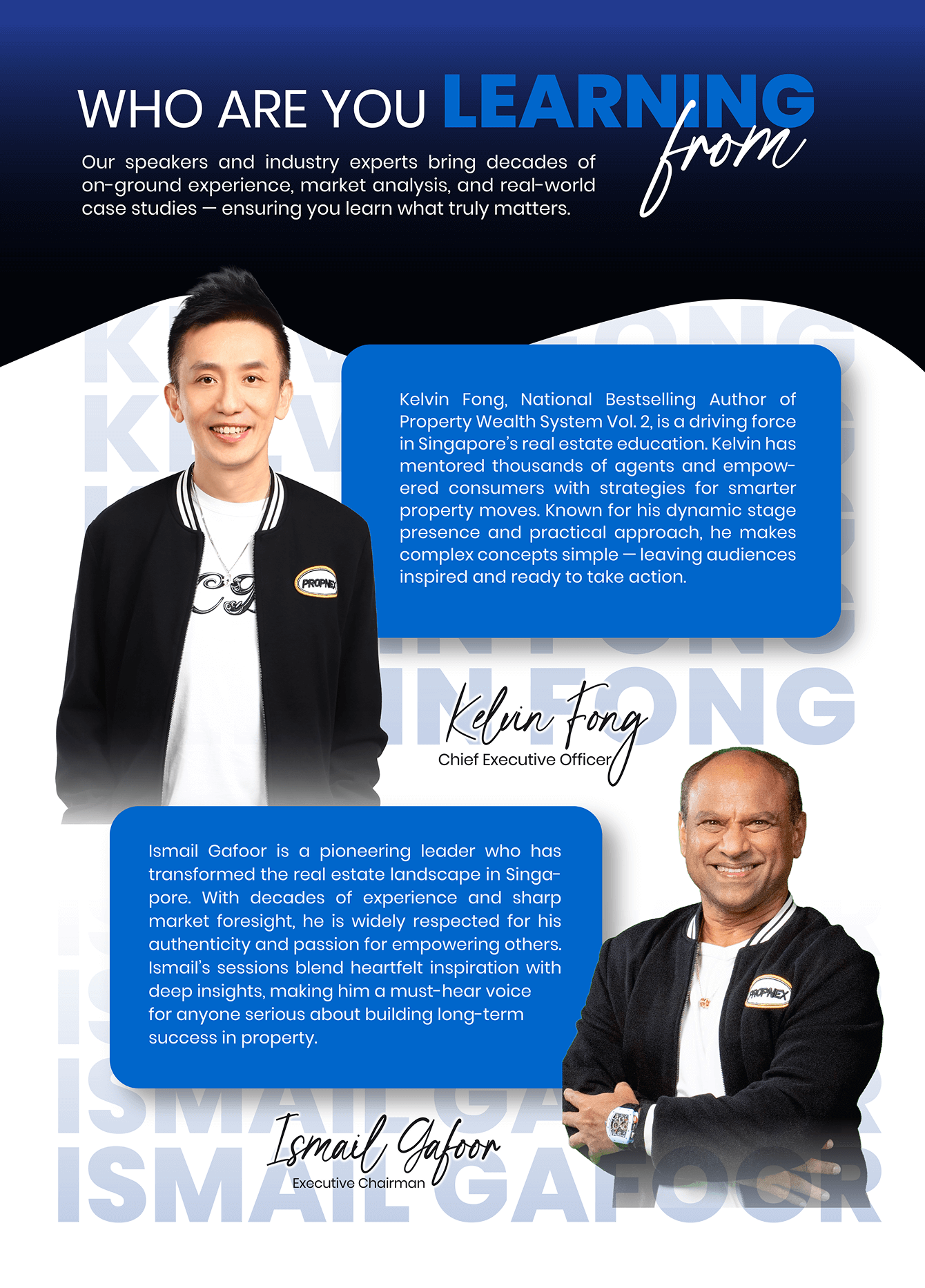

Our speakers bring decades of real estate experience, backed by market research and real case studies. Hear directly from experts who have guided thousands of consumers and investors.


01 Are these seminars free to attend?
02 Who should attend?
03Do I need prior property knowledge?
04 Can I ask questions during the seminar?
05 Is this Learning Hub only about seminars?
Frequently
Asked Questions
Deep-Dive Learning Pathways
Beyond introductory concepts, our PWS Masterclass offers a structured, hands-on approach for homeowners and investors ready to plan long-term wealth strategies.
For those who want to go deeper, the Property Wealth System (PWS) Masterclass is a 2-day immersive workshop where you’ll:
Apply the same frameworks you learned at CES in a hands-on way
Learn to calculate and assess your own property portfolio and “property health”
Build a clear, step-by-step action plan for long-term wealth creation through property
Think of CES as your starting point to understand the market — and PWS as your roadmap to take decisive action with confidence.